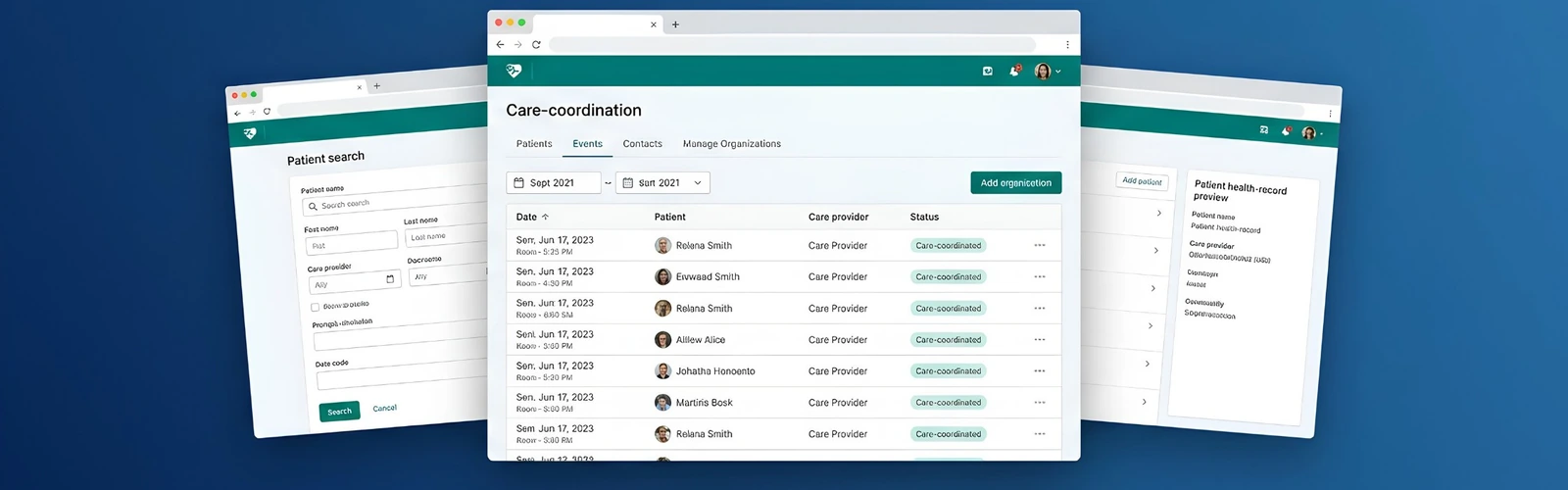
A Care Team Coordination Web App for 120+ Care Providers
About the Client
The Client is a US company that provides hospitals, ancillary providers, and assisted living organizations with first-rate solutions to collect, process, and analyze clinical data, including patient, treatment, and medication information. The end customers are over 120 care providers using the Client's services.
Connecting Care Teams to React Quickly Around Each Patient
The end customers' ultimate goal was to provide patients with care teams that would be connected to each other and ready to react quickly. To help them fulfill this goal, the Client commissioned INNERLUXES to create an application that would organize care teams around each patient's medical condition with the ability to exchange information on changes in the patient's current health status.
A Care Coordination Module With Event-Driven, Role-Based Alerts
The solution is implemented as a care coordination module in software that INNERLUXES's medical app development team also created. The application allows storing and exchanging medical documents in the CCD format (with clinical, demographic, and administrative patient data) among physicians, nurses, and other care team members.
The main function of the care coordination module is to receive and process information about patients' conditions and notify care team members about specific "events", such as:
- Serious injury
- Medical emergency
- Suspected abuse
- Medication errors
- Adverse reaction to medication
- Unexpected serious illness
- Accident requiring treatment
- Fire or force-majeure event requiring relocation of services for more than 24 hours
- Circumstances involving a law enforcement agency or fire department related to the health, safety, or supervision of an individual
- Hospitalization
- ER visit
- Suspected exploitation of a vulnerable adult
- Life events (for example, a change in guardianship or starting a new job)
- Signs of depression
- Change in behavior
- Medication non-compliance
- A barrier to service (for example, lack of transportation)
- General change in functioning
In the application, a care team includes both clinical and non-clinical members, and each member has its own role, for example:
- Care Coordinator — responsible for ensuring that a patient receives the needed health and social services.
- Case Manager — the person administratively responsible for a particular case.
- Parent/Guardian — the official patient's representative, a first-contact person and the main decision maker in critical situations.
- Primary Physician — a physician, doctor, or nurse providing care on an outpatient basis.
- Behavioral Health — a specialist treating patients' behavioral health issues, such as stress, depression, anxiety, addiction, mood disorders, or other psychological concerns.
So, how does it work?
During the care cycle, different care team members track each patient's health status. When a patient experiences one of the above conditions ("events"), a health specialist (for example, a surgeon, physician, or nurse) creates a new event and describes the issue. The event can be created in the EHR, PMS, LIS, RIS, or another system, as well as in the module itself.
The created event is then sent to the care team members according to the RACI matrix — a set of automatic rules defining which specialists are subject to each event type and their level of responsibility.
For example, when a patient suffers a serious injury, an event is sent to the Case Manager, Care Coordinator, Parent/Guardian, Primary Physician, and Behavioral Health — but only the Care Coordinator and Primary Physician are accountable and expected to take action.
Each member can be notified via SMS, email, secure in-app messages, or fax, and team members can edit their channel preferences according to their roles.
Real-Time Care Teams for 120+ Providers
More than 120 hospitals, assisted living organizations, and health systems can now integrate the application to offer better care to their patients. Each patient acquires their own care team that is aware of the person's overall health status and well-being in near real time. By receiving timely notifications about patient "events", the care team can proactively intervene or respond appropriately.
To ensure an intuitive user experience for medical staff, the application includes the following settings:
- Patient management — a list of patients associated with a particular system user (care team member), patient details (personal and contacts), patient care team members, patient events, and the preferred notification type.
- Care team member management — a list of care team members for a particular patient and their details.
- Event management — a list of events and details (time range, event type, contact, organization).
- Notification history — a list of messages and details (time range, event type, communication channel, patient, organization).
- Contact management — a list of contacts and details (general data, address, phones, preferred notifications).
App navigation is supported by filtering and text search to enable a fast, seamless workflow.
Technologies and Tools
HTML, CSS, JavaScript, jQuery, Twitter Bootstrap, Java EE 8, Java Spring, Hibernate ORM, Microsoft SQL Server.