7 Big Data Challenges and Practical Solutions to Each

Related topics:
7 min read
Last updated:
Big data projects rarely fail because of the technology itself. They fail because teams walk in without knowing which obstacles are waiting for them — and every one of those obstacles is well documented by now. Once you can name each “monster” and know how it behaves, none of them is particularly frightening.
Below, our big data consultants break down the 7 challenges that derail most big data initiatives and share the countermeasures we apply in real projects. Armed with this knowledge, you can plan your data-driven transformation with open eyes instead of learning each lesson the expensive way.
A quick look at the market first. A survey by Matillion and IDG found that enterprise data volumes grow by roughly 63% per month, and 12% of the surveyed organizations even reported 100% monthly growth. Companies treat this data as a decision-making foundation: Statista reports that 75% of businesses worldwide rely on data to drive innovation, and 50% say data is what keeps them competitive. A survey by Digital Realty adds that over 50% of organizations use data to build new products and services, improve customer experience, and reduce risk and security exposure.
No wonder adoption keeps climbing across industries: in healthcare, financial services, and telecom, big data and AI adoption ranges between 90% and 100%. Add the fact that big data now fuels nearly every AI and analytics initiative, and the conclusion is simple: these challenges are absolutely worth solving.

Challenge #1: Weak Understanding and Acceptance of Big Data
Surprisingly often, organizations start a big data initiative without a shared answer to the basics: what big data means for their business, which benefits they expect, and what infrastructure and skills the project requires. Without that clarity, budgets and months of work get burned on tools nobody knows how to apply.
There is a human side too. If employees don’t see the value of big data — or simply don’t want their familiar processes changed — they will quietly resist the new solution and stall the company’s progress.
Solution:
Big data is an organizational change before it is a technical one, so acceptance has to start with top management and travel down from there. Structured trainings and workshops for every affected team are the proven way to build understanding at all levels.
Adoption itself should be monitored: track how the new solution is actually used and correct course early. Just keep the control proportionate — heavy-handed oversight tends to create the very resistance you are trying to avoid.
Challenge #2: Confusing Variety of Big Data Technologies
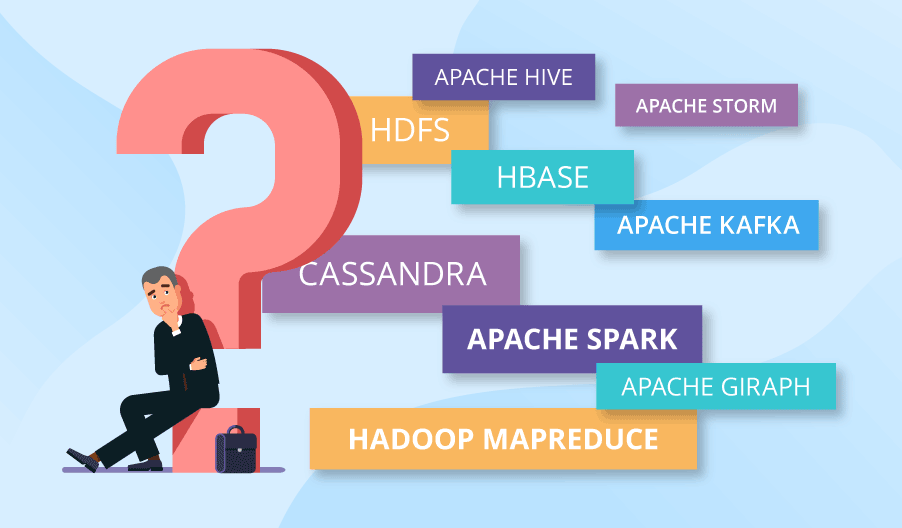
The big data tooling landscape is genuinely overwhelming. Should you run Spark, or is Hadoop MapReduce fast enough for your workloads? Is Cassandra or HBase the better store for your access patterns? Each wrong call at this stage translates directly into poor performance and wasted spend later — and can single-handedly kill the ROI of the whole initiative.
Solution:
If your team is new to the ecosystem, don’t guess — bring in expertise. Hire an experienced engineer or engage a consulting partner, work out the strategy together, and only then lock in the technology stack that fits your specific workloads and budget.
Read more:
- Spark vs. Hadoop MapReduce: which big data framework to choose
- Apache Cassandra vs. Hadoop Distributed File System: when each is better
- Cassandra vs. HBase: twins or just strangers with similar looks?
Challenge #3: High and Hard-to-Predict Costs
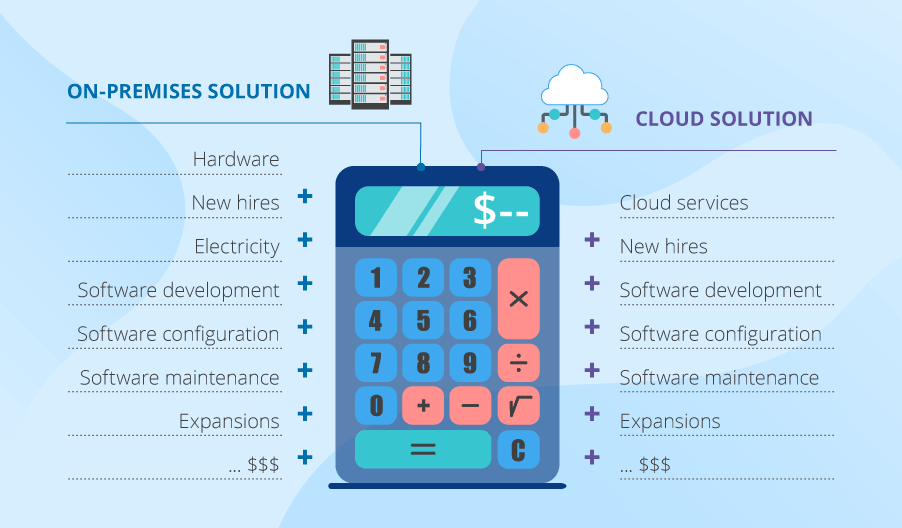
Big data adoption is expensive in ways that are easy to underestimate. An on-premises deployment means paying for hardware, new hires (administrators and developers), and electricity — and even though the core frameworks are open source, the development, setup, configuration, and maintenance of the software still cost real money.
Going cloud doesn’t make the bill disappear: you still need skilled staff, plus payments for cloud services, solution development, and the setup and upkeep of the required frameworks.
And in both models, you must budget for future growth up front — otherwise expanding data volumes will quietly turn into runaway spend.
Solution:
There is no universal money-saver; the right setup follows from your technology needs and business goals. Companies that value flexibility usually win with the cloud, while organizations under extremely strict security requirements stay on-premises. Hybrid architectures — part of the data in the cloud, part on-premises — often turn out to be the most cost-effective compromise.
Two more levers reliably reduce the bill when applied properly:
- Data lakes offer inexpensive storage for the data you don’t need to analyze right now.
- Algorithm optimization can cut computing power consumption by 5–100 times — sometimes even more.
The common thread: analyze your actual needs first, then choose the course of action — not the other way around.
Challenge #4: Complexity of Managing Data Quality
Data from diverse sources
Sooner or later every big data team hits the integration wall: the data worth analyzing arrives from many sources in many formats. According to the Digital Realty survey cited above, enterprises juggle around 400 data sources on average. An ecommerce company, for instance, pulls website logs, call center records, competitor price scans, and social media streams — and matching records across them is hard. Your solution must figure out that SALOMON QST 92 17/18, Salomon QST 92 2017-18, and Salomon QST 92 Skis 2018 are the same product, while two companies with nearly identical names are entirely different entities.
Unreliable data
Big data is never 100% accurate, and by itself that’s not fatal. But “not fatal” doesn’t mean “ignorable”: raw data carries errors, duplicates itself, and contradicts itself. Feed severely low-quality data into a precision-sensitive business task, and instead of insights you get expensive noise.
Solution:

A whole discipline of data cleansing exists for this, but the order of operations matters. First, design a proper data model for your big data. Only with the model in place do the standard techniques pay off:
- Compare incoming data to a single point of truth (e.g., validate address variants against the postal system’s canonical spellings).
- Match records that describe the same entity and merge them.
And accept the fundamental fact: big data will never be 100% accurate. The skill is managing quality to the level your use cases actually require — this article on big data quality digs into exactly that.
Challenge #5: Demanding Data Governance
Data governance covers data integrity, regulatory compliance, and security across the entire data lifecycle. Per Precisely, 71% of organizations now run a data governance program, and most see real payback: 58% report better analytics and insight quality, another 58% improved data quality, and 57% stronger collaboration. Yet more than half of the same respondents rank governance among their top challenges. For big data specifically, the complexity comes from three directions:
- Most big data is unstructured (video, audio, free text), which makes it inherently harder to classify and protect.
- Big data security challenges go beyond traditional data protection: threat detection lags behind data velocity, cross-border storage creates legal risk, and aggregated datasets open the door to inference attacks.
- Big data feeds AI-powered analytics and real-time processing. Building a system that delivers real-time output and enforces security and integrity requirements at the same pace is genuinely hard — and AI adds the extra duty of auditing data for ethical use and bias.
Weak governance has a visible price tag. IBM puts the global average cost of a data breach in 2024 at $4.88 million, while Gartner estimates that poor data quality costs organizations at least $12.9 million per year on average.
Solution:
When building a big data governance framework, prioritize these four areas:
- Systematic data quality mechanisms — cleansing, profiling, and continuous monitoring.
- Named data stewards who oversee compliance with data policies across the organization.
- Mature security controls that preserve data privacy and integrity end to end.
- Modern tooling as a force multiplier: AI-powered tools can discover sensitive data, recommend or auto-enforce protection policies, and flag anomalies in real time. Cloud platforms are worth considering here too, as they ship with richer governance tooling than most on-premises stacks.
Challenge #6: Turning Big Data Into Valuable Insights
Collecting data is the easy part; converting it into decisions is where companies stumble. A Clootrack survey found that 18% of businesses struggle to transform data into insights, and the Digital Realty study explains why: underinvestment in analytics tools and infrastructure, customers reluctant to share data, and data scattered across silos.
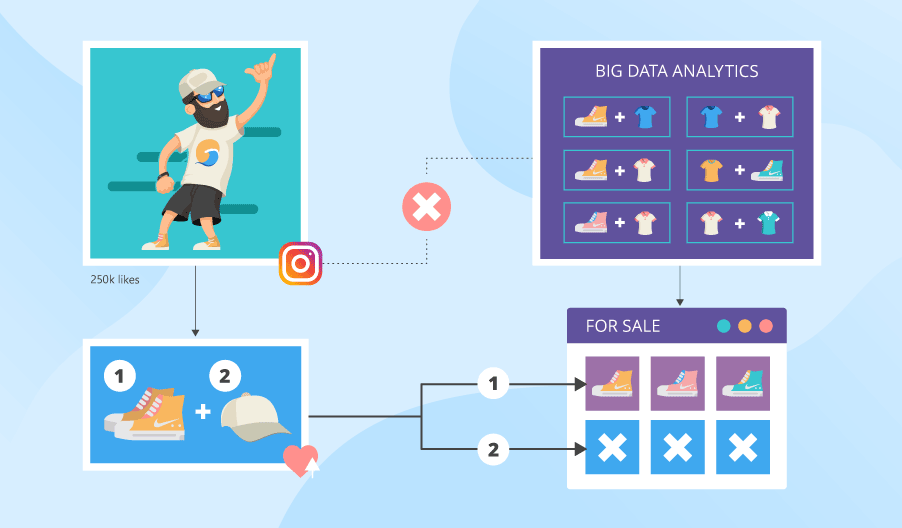
Here’s what the gap looks like in practice. Suppose your retail analytics recommends item pairs purely from historical purchase data. Meanwhile, a popular athlete posts a photo in white sneakers and a beige cap, the look goes viral, and shoppers rush to copy it. Your store still has the sneakers but sold out of beige caps weeks ago — lost revenue, disappointed customers. A competitor whose analytics also watches social signals caught the trend in time, stocked both items, and is now offering a bundle discount on the pair.
Solution:
Design a deliberate system of factors and data sources that your analytics engine takes into account — and be ready for that system to include external sources, even when external data is harder to obtain and process.
Bring in consultants to review your business processes together with your analytics setup and pinpoint where data value leaks away. You can see how INNERLUXES helped a multibusiness corporation eliminate data silos and centralize 15 disparate data sources — unlocking a 360-degree customer view, smarter stock management, and a set of other analytics-driven wins.
AI is also proving itself as an insight amplifier: it sharpens forecast accuracy in real-time scenarios such as payment fraud detection and democratizes analytics by letting non-technical users query data in plain language. Budgets for such solutions vary widely — from around $30,000 to $1,000,000 — but the payoff is documented: a Forrester study reports that 63% of data and analytics leaders make faster and better decisions after applying AI/ML to their data.
Challenge #7: Troubles of Upscaling
The defining trait of big data is that it keeps growing — dramatically. And one of its most serious challenges hides exactly there.
The concern isn’t adding processing or storage capacity; that part is straightforward. The hard part is scaling up without degrading system performance and without blowing the budget. If your architecture can’t absorb data growth without major rework, every growth spurt means repeated investment and downtime. For a real-world contrast, here is how INNERLUXES helped a US retailer accommodate rapid big data growth and reach 100x faster data processing without disrupting day-to-day operations.
Solution:
The first line of defense is a decent architecture for your big data solution — the better it is, the fewer scaling issues surface later. The second is designing your algorithms with future upscaling in mind from day one.
Beyond that, plan for ongoing maintenance and support so that growth-related changes are handled properly as they come, and run systematic performance audits to catch weak spots before they become incidents.
Big Data Challenges and Their Solutions in a Nutshell
| Challenge | Solution |
1. Weak understanding and acceptance of big data. |
Run trainings and workshops, monitor technology adoption, and take corrective measures early. |
2. Confusing variety of big data technologies. |
Involve experts to select a stack with the right balance of performance, security, and cost-efficiency for your workloads. |
| 3. High and hard-to-predict costs. | Use a data lake for cheap raw-data storage and optimize processing algorithms to cut compute consumption. |
4. Complexity of managing data quality. |
Build a shared data model, validate against a single point of truth, match and merge duplicate records, and monitor quality continuously. |
5. Demanding data governance. |
Establish a governance framework covering data stewardship, quality, security, and compliance; reinforce it with advanced tools like AI-driven policy enforcement. |
6. Turning big data into valuable insights. |
Add modern analytics capabilities (real-time, AI-powered), eliminate data silos, and strengthen the analytics infrastructure. |
7. Troubles of upscaling. |
Design future-proof architecture and algorithms; if a revamp is already due, make the new version growth-ready. Plan continuous maintenance and support. |
Win or Lose?
Notice the pattern: nearly every challenge above can be anticipated and neutralized if your big data solution stands on a well-organized, thought-through architecture. That calls for a systematic approach — and a handful of habits worth keeping:
- Run workshops for employees to secure genuine big data adoption.
- Select the technology stack deliberately, not by fashion.
- Keep costs visible and plan for future upscaling from the start.
- Accept that data is never 100% accurate — and manage its quality anyway.
- Dig deep and wide for insights that actually change decisions.
- Never put big data security on the back burner.
Follow these principles, and the “scary seven” turn out to be very beatable.